



Business Capability Instances? Your thoughts?

  • September 5, 2025
  • 3 replies
  • 193 views

Fab
Forum|alt.badge.img

Hi all, 


We are in the process of reshaping a bit the way we would like to assess the maturity of our business capabilities. Sometimes, the business capabilities are duplicated across the organization, and may be supported by different contexts. For each context, we can think of a single version of the capability realized by a distinct set of People/Process/Techno/Data. 

When we try to assess the maturity of a capability using the current model, it becomes difficult to measure when it is captured at one level. The average maturity could be a 3 out of 5, but at that point we don’t really know if there is an issue, and where it is. There could be some instance that scores a 1, but another one scoring a 5. Having an average 3 wouldn’t perhaps raise flags.

I was thinking about the “capability instances” and how it would play out if we created a single version for each variant of PPTD. At the Instance level, create 4 single-select fields for maturity, at the capability level, create 4 calculations to avg the children.
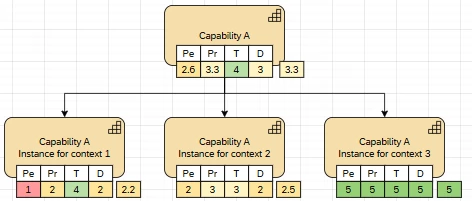
in this scenario, I would attach to each instance their respective relations (at least for Org/Applications, maybe processes). A downside is that we add another parent-child level and have to manage the roll-ups with calculations - now at least more easily with Calculations.
 

Another option, if the instantiation is solely by LOB, then create the maturity fields on a custom relation Organization - Capabilty, thus losing the separation of apps, processes, etc.
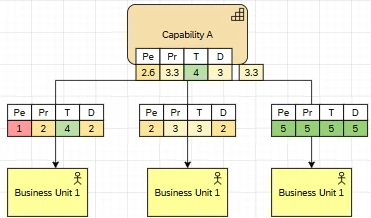
 

Have you considered such approach and if yes, how did you ended up doing it? 🤔

I also noted some other approach using a subtype of Business Context but I would perhaps keep it under the same object


3 replies

Forum|alt.badge.img
  • Royalty For Loyalty
  • September 5, 2025

Hi
Seems you want to model company-wide business capability assessments
as a aggregation/combination of lower organizational-level assessments.

Sounds like a realistic approach - Key is aligning the model to your organization business. That is great.


Fab
Forum|alt.badge.img
  • Author
  • Veteran
  • September 5, 2025

Hi
Seems you want to model company-wide business capability assessments
as a aggregation/combination of lower organizational-level assessments.

Sounds like a realistic approach - Key is aligning the model to your organization business. That is great.

There are caveats to this approach though. Whatever option we choose, it has to be standard across all BUs and account for cases where there is no duplicate capability (only one instance).

I wanted to bounce with others before going down a rabbit hole.

If we did create a subtype for this case, we could technically hide it from users, as soon as the permissions per subtype is delivered: https://roadmap.leanix.net/c/498-inventory-subtype-specific-permissions . We could then make it visible only to relevant persona.

I also noted that I copied “Business Unit 1” 3 times in my second image 😐 I guess readers will disregard this typo !


Forum|alt.badge.img
  • Royalty For Loyalty
  • September 5, 2025

I my opinion, the second approach is more flexible

I’d like to recommend just one advice… try to create the report associated with your “use case”. I’d try the first one and simulate the report and find out if the model is usefull