



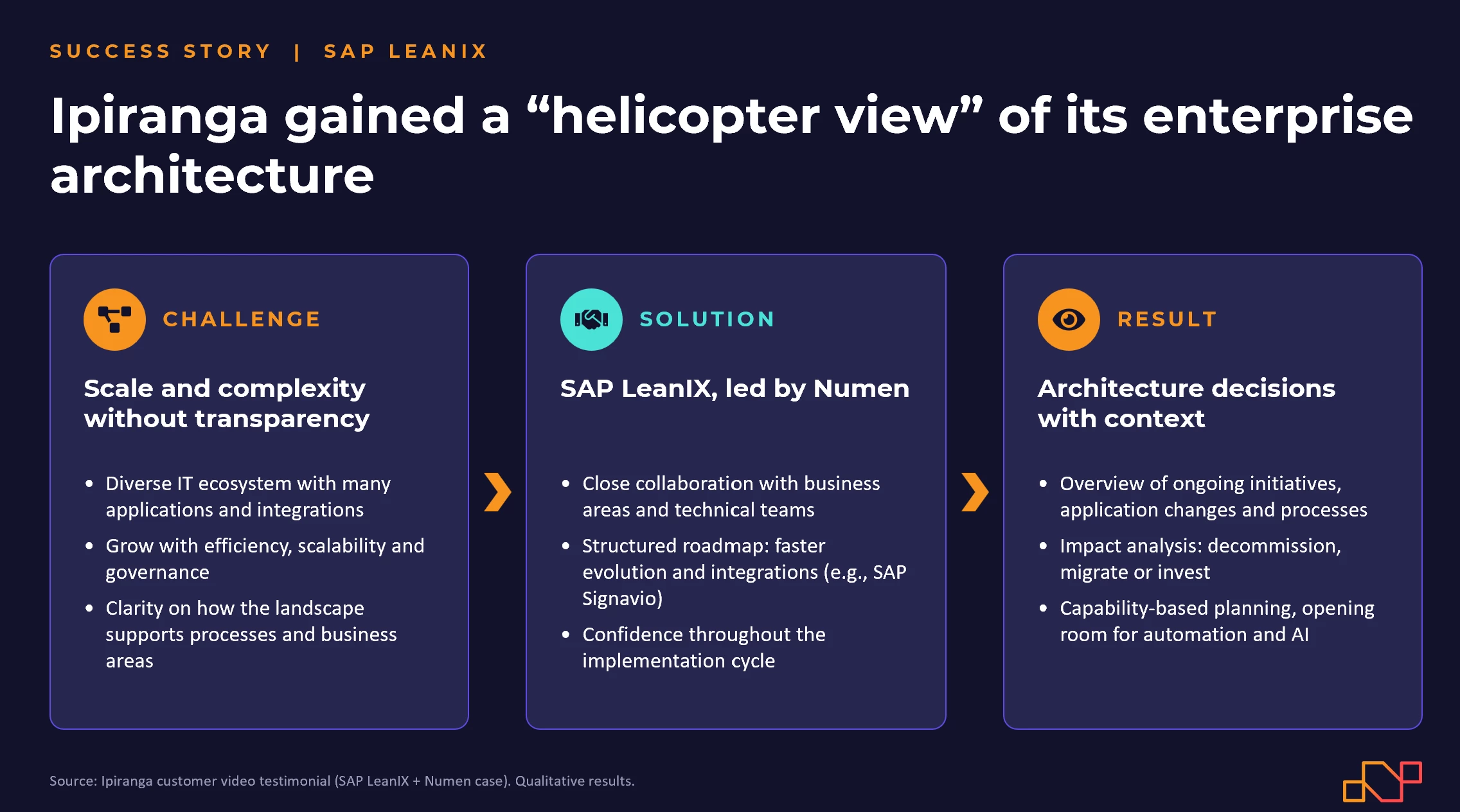
Ipiranga, one of Brazil’s largest fuel distributors, runs a complex operation (a wide network of service stations, distribution bases and partners) on top of a very diverse IT ecosystem.
The challenge their team described: keep growing with efficiency and scalability, while keeping governance over many applications and integrations, and having a clear view of how the landscape supports business processes and areas.
They adopted SAP LeanIX with Numen as implementation partner. What stood out in their feedback:
-
Close work with both business and technical teams
-
A structured roadmap that accelerated evolution and integrations
-
Confidence throughout the implementation cycle
What changed, in their words, is a “helicopter view”:
-
Clarity on all initiatives, application changes and processes in flight
-
Easier impact analysis: what to decommission, where to invest, what to migrate
-
Capability-based planning aligned with market best practices (they mentioned Gartner’s recommendations), which opens room for automation and AI
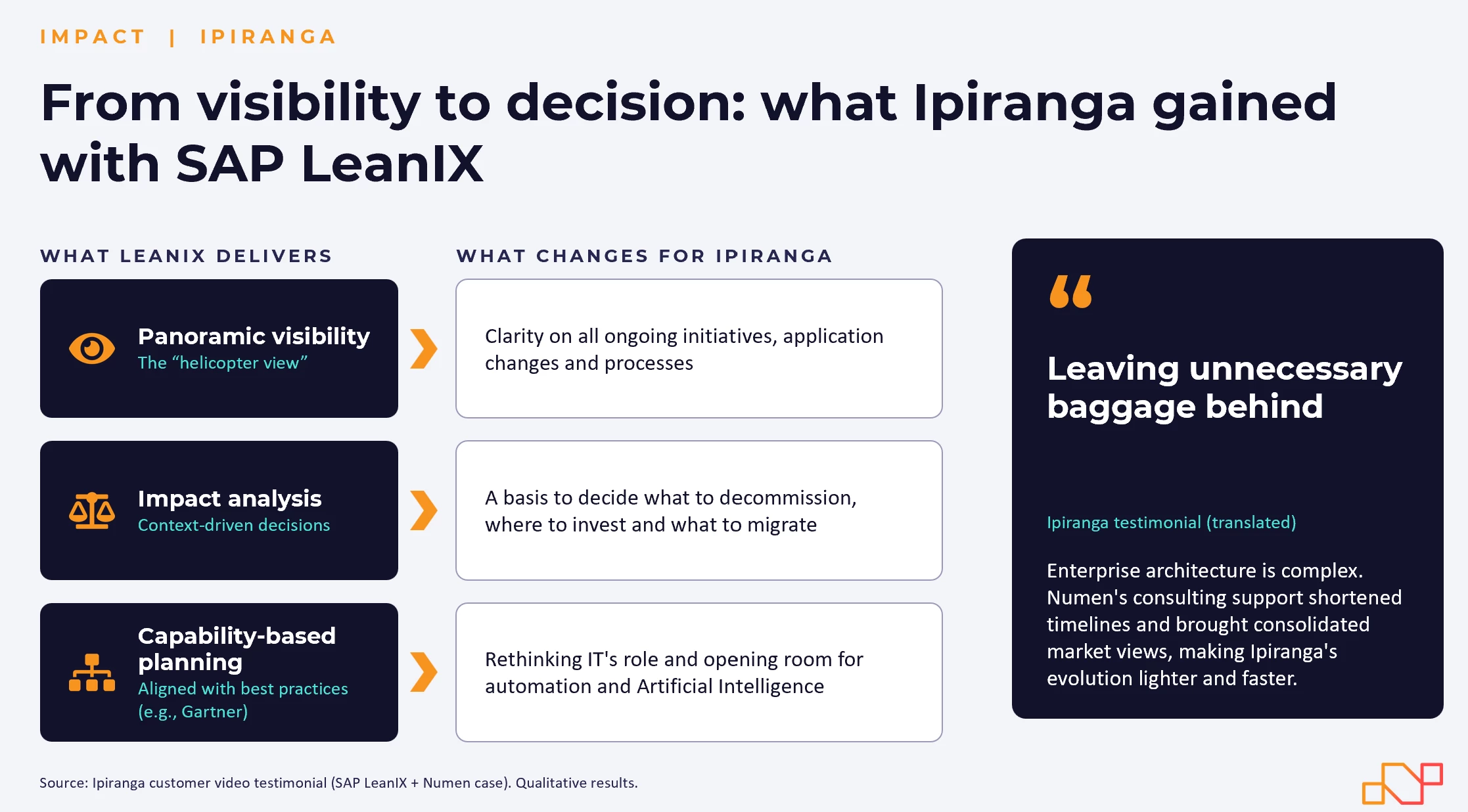
Their takeaway: enterprise architecture is complex enough to justify accelerators. Consolidated market views helped them shorten timelines and “leave unnecessary baggage behind.”
For those running LeanIX at scale: how do you connect your capability map to decommissioning decisions? Did you start from capabilities or from the application inventory?
Full disclosure: I work at Numen, the implementation partner on this project.
Our Core Takeaways from this Project
-
Decisions over data: Frame the initiative around 3–5 high-value questions (e.g., decommissioning, impact analysis) rather than cataloging everything upfront.
-
Keep the model lean: Start with a minimal metamodel (applications, capabilities, owners, lifecycles) to ensure it remains maintainable; expand only when justified by specific business needs.
-
Data hygiene is the real effort: Tool configuration is quick compared to resolving duplicate records, conflicts, and missing information during initial imports.
-
Sustained ownership prevents decay: Every application needs an assigned owner and a scheduled review cadence, or the data quickly becomes untrusted and obsolete.
-
Blend automation with human context: Automated integrations capture technical specifications, but business criticality, capability alignment, and organizational fit require direct human input.
-
Co-design capabilities with the business: Tailor reference models directly to your organization with active business validation; an IT-only taxonomy will be ignored.
-
Drive adoption through stakeholder value: Focus on change management by delivering targeted reports that directly answer each stakeholder group's specific priorities.
Watch the full testimonial: