










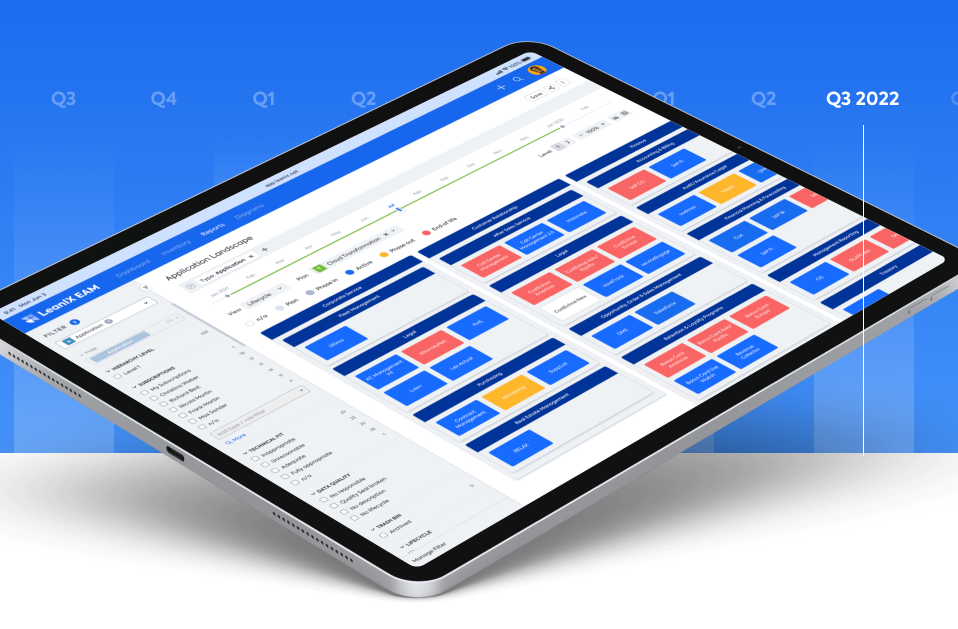

Introducing the SAP LeanIX Community Champions Contest 2026
Discuss & learn how to evaluate and optimize your organization’s application portfolio with LeanIX.
Recently active
Building on the definitions of IT Component Lifecycle dates and assuming these dates are provider dates, then I have a dilemma about understanding which IT Component is currently in use. Consider this: I add an IT Component, say MyFirewall version 1. I use the lifecycle catalog to add the provider lifecycle dates. I notice MyFirewall v1 is in Phase Out. I clone the factsheet and update the version number, and make MyFirewall v2 the successor of MyFirewall v1. I use the lifecycle catalog to add the provider dates for MyFirewall v2 - it is in the Active lifecycle state.At this point I don’t know which MyFirewall version I’m using in Production because the dates are the provider dates, not my organisation’s lifecycle dates.It seems to me that using the Lifecycle Catalog only makes sense when the IT Component supports an Application (which gives you your organisation’s lifecycle dates).Do I understand correctly or am I missing something?
Hi all, I have a new question:Say we have applications made of IT components and each IT component is linked to a provider (i.e. vendor).Can you search in the inventory for all apps that have at least 1 IT component from a specific vendor? I have tried but I could not find how apart from accessing the relationship explorer for the provider I am interested into, but I’d like a search or a report instead.
The help text on the IT Component lifecycle dates seems to imply these are dates when the organisation is doing something with the component rather than dates when the provider is doing something. It seems to me, given the Lifecycle Catalog supplies provider dates, that the help text needs to be reworded, e.g.Plan - The component has been announced by the provider Phase in - The component is in beta or early access Active - The component is generally available Phase out - The component has reached end of support. Extended support may be offered by the provider. End of life - The component is end of life and no longer supported by the providerIs this the correct interpretation of the dates provided by the Lifecycle Catalog? Has anyone adjusted their help text and is willing to share their wording?
I would like configure the application fact sheet to add a relation to another application fact sheet.If I click on one section and then on “Add Relation” I can create a relation to any other type of fact sheet, but not application.Is this a known limitation? Or is there a way to relax some constraint somewhere to enable it? Thank youRoberto
I think I heard that real-time was appropriate for IOT, and ad hoc for RESTful API’s. How are you using these values? What about Kafka?
Hello, I’m not sure that the right place to put this question … but I’m trying. I’ve launched a survey few days ago which targeted several users (application accountable). Some user inform me that accountable have changed. Two case exist :1st case : user answer the 1st question to confirm is the accountable, if not they have text filed to give the name of the new accountable. In this case the survey are considered done. 2nd case : use inform me by email to change the accountable (but user don’t answer the survey). They have a way to :relaunch the survey on specific fact sheet ? (without running a new survey with dedicated target, in order to have global overview of the survey). automatic update the target user of a survey (if the fact-sheet subscription was updated) Currently I use the old survey engine (because I have some fact-sheet element and conditionality). Thanks you in advance.
Application Portfolio Assessment with LeanIX: Maximizing the Benefits In this article, we will explore the benefits of conducting an APA with LeanIX and how it can help organizations achieve their objectives.Reduces IT CostsOne of the most significant benefits of an APA with LeanIX is the reduction of IT costs. By identifying redundant, outdated, or underutilized applications, organizations can eliminate unnecessary expenses associated with application maintenance, upgrades, and licensing. An APA can also help identify opportunities for consolidation or replacement of applications, resulting in more streamlined IT infrastructure and lower overall costs.Provides Insights for Decision-makingConducting an APA with LeanIX produces data-driven insights that drive informed and strategic planning decisions. The EAM tool enables companies to visualize data in the form of heatmaps, charts, and dashboards that facilitate analysis and identify areas for improvement. The application landscape insi
Application Portfolio Assessment (APA) is usually the first step on your journey with LeanIX. It helps you build a repository of your applications and drive faster technical and functional assessments. As companies continue to grow and evolve, their IT landscape often becomes increasingly complex. Application portfolios can expand and therefore become disorganized, making it challenging to manage and maintain them effectively. That is where Application Portfolio Assessment (APA) is used.Application Portfolio Assessment (APA) involves the analysis of an organization's Application Portfolio to understand its strengths, weaknesses, risks, and opportunities. By conducting an APA, companies can identify any redundant, outdated, or trivial applications and systems, which can help reduce IT costs and improve overall efficiency. Additionally, an APA can help companies identify new opportunities for innovative and emerging technologies.LeanIX and its APA module provides in-depth insights into a
The application portfolio is an essential aspect of any IT landscape. Ensuring that the portfolio is optimized to meet an organization’s operational and financial needs is the key to ongoing business success.By reducing complexity, managing cost, and aligning applications with critical business capabilities, organizations can improve their overall effectiveness and competitiveness. A well-organized, up-to-date application repository is essential for all these initiatives. Complex spreadsheets just can’t do the job.Why is application rationalization a relevant use case?For most of the organizations that are using LeanIX, application rationalization is a key use case. The goal is to clean up their application landscape and achieve efficiency gains and reduce costs right away.Application rationalization can also pave the way for other use cases. These initiatives are much easier to realize once you have an efficient IT landscape in place and all redundancies and inefficiencies have been r
Already have an account? Login
No account yet? Create an account
Enter your E-mail address. We'll send you an e-mail with instructions to reset your password.